
You likely already know Apex Trader Funding as a major provider of virtual capital in the futures proprietary trading space. However, their massive operational overhaul in March 2026 completely rewrote the rules for securing and extracting funds. Relying on outdated information regarding these specific changes can quickly cost you evaluation fees.
If you are searching for an honest and up-to-date Apex Trader Funding review, you need the exact facts about this new business model. This article provides a direct, highly detailed breakdown of the firm following its recent structural updates.
We explain the exact rule modifications, the new account structures, and the strict payout limits you must fully understand before purchasing an evaluation.
Key Takeaways
- Apex Trader Funding eliminated recurring monthly fees in favor of a one-time evaluation cost.
- Traders face a strict 6-payout cap per Performance Account before the account is permanently closed.
- The firm introduced a 50% consistency rule for all approved withdrawals.
- Evaluation accounts are strictly divided into End-of-Day (EOD) and Intraday Drawdown models.
- Passing requires a mandatory one-time activation fee before receiving a funded account.
Apex Trader Funding at a glance:
| Feature | Details |
|---|---|
| Evaluation fee structure | One-time upfront fee. |
| Account types | Divided into two models: End-of-Day (EOD) Trail and Intraday Trail. |
| Account sizes | $25K, $50K, $100K, $150K. |
| Payout limit | Maximum of 6 payouts (The account is permanently closed after the 6th payout). |
| Consistency rule | 50% consistency rule applied to all approved withdrawals. |
| Profit split | Traders receive a 100% profit split on all payouts. |
| Maximum accounts | Allows trading (copy trading) up to 20 accounts simultaneously. |
| Passing time requirement | No minimum trading days required (Can be completed in 1 trading day). |
| Activation fee (PA fee) | Mandatory one-time fee within 7 days of passing the evaluation. |
Disclaimer: Trading futures involves substantial risk of loss and is not suitable for all investors. The information provided in this review is for educational purposes only and does not constitute financial advice. Proprietary trading firm rules, fees, and conditions are subject to rapid change. Please verify all current details directly with Apex Trader Funding before making any financial commitments.
1. Apex Trader Funding: Overview & recent updates
The proprietary trading landscape shifted significantly when Apex Trader Funding completely updated its business model to manage risk differently. The firm adjusted its rules to focus heavily on short-term capital extraction rather than long-term career building.
1.1. What is Apex Trader Funding?
Apex Trader Funding provides virtual capital to traders who pass a simulated evaluation phase. The company evaluates retail traders in a simulated environment and funds those who demonstrate profitable trading alongside strict risk management. You provide the execution strategy, and the firm provides the simulated funding.
Founded in 2021 and headquartered in Austin, Texas, the firm has grown into one of the largest retail futures prop firms globally. Their primary goal is to empower those who can pass to move forward to a performance account for the potential to get paid based on their trading results.
1.2. March 2026 rule updates
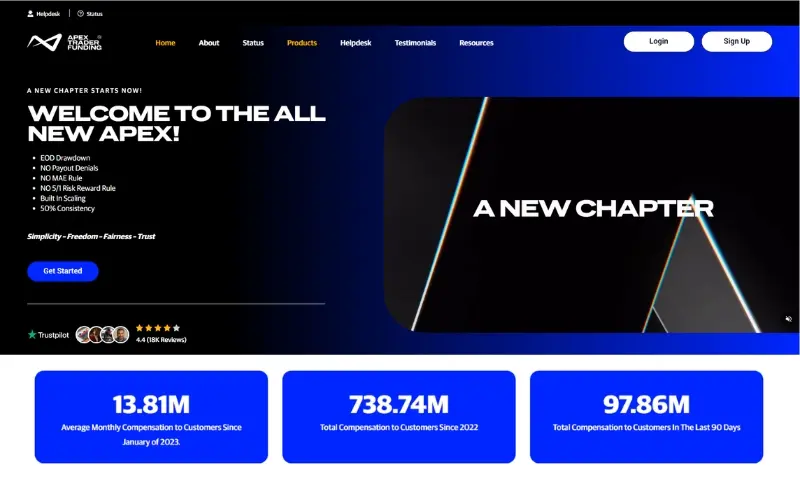
On March 1, 2026, the company eliminated recurring monthly fees and introduced a strict cap on payouts. Legacy accounts purchased before this date cannot be converted into the new Intraday or EOD Performance Accounts.
The firm added strict one-time fees, implemented a 50% consistency rule, and created a hard division between EOD and Intraday drawdown accounts. These changes force you to choose your exact risk management style before purchasing a challenge.
Here is a clear comparison between the old and new structural models:
| Feature | Old model (pre-March 2026) | New model (March 2026) |
|---|---|---|
| Evaluation fees | Recurring monthly subscription | One-time upfront fee |
| Payout limit | Unlimited payouts | Strict 6-payout cap |
| Consistency rule | 30% rule | 50% consistency rule |
| Account types | Standard trailing drawdown | Split into EOD and Intraday models |
1.3. Pros and cons
Every proprietary firm has operational trade-offs that you must accept before committing capital. The following table isolates the fundamental benefits and drawbacks of the updated model, providing a comprehensive view of what to expect:
Pros
- 100% Profit Split: Traders receive a 100% profit split on all approved payouts.
- One-Time Fees: Upfront evaluation fees eliminate the anxiety of recurring monthly subscriptions.
- Speed to Pass: No minimum trading days are required, allowing traders to pass the evaluation in a single day.
- Massive Scaling: You have the ability to copy trade across up to 20 funded accounts simultaneously.
- News Trading Permitted: Traders are fully allowed to hold positions through major macroeconomic news events.
- Multiple Platforms: The firm integrates with reliable software, including Rithmic, Tradovate, and WealthCharts.
Cons
- Strict 6-Payout Cap: The account closes permanently after the 6th payout, forcing you to start over.
- 50% Consistency Rule: This rule slows down large withdrawals and penalizes single-day profit spikes.
- Intraday Drawdown: The trailing drawdown calculates tick-by-tick based on unrealized intraday profits.
- No Evaluation Resets: Failing an account means you must purchase a brand new evaluation at full price.
- Strict PA Activation Window: Mandatory activation fees must be paid within 7 days of passing.
- Geographical Restrictions: An extensive restricted countries list blocks many international traders.
The new model makes it financially easier for new traders to attempt evaluations due to the removal of recurring fees. You no longer have to worry about a monthly subscription draining your account while you take your time to pass.
Conversely, the strict six-payout cap makes it significantly harder to build a long-term income stream from a single account. You must now treat these accounts as temporary capital injections. This requires a constantly rotating pipeline of new evaluation accounts.
2. Account types: EOD vs. intraday drawdown
You must choose between two distinct drawdown calculation methods when purchasing your evaluation. This choice dictates how your daily losses and maximum drawdowns are measured, heavily impacting your trading psychology.
2.1. End of Day (EOD) trail
The End-of-Day calculation provides more breathing room during the active trading session. The EOD drawdown sets the lowest balance your account is allowed to reach.
This metric is calculated once per day at market close, specifically at 4:59:59 PM ET, based on your closing account balance. EOD Evaluation accounts have a fixed Daily Loss Limit during the trading session that you must respect to avoid a temporary pause.
Here is the exact pricing and target breakdown for the End of Day (EOD) trail evaluations:
| Size | Price | Profit target | Max drawdown | Daily loss limit | Max contracts |
|---|---|---|---|---|---|
| 25K | $199 | $1,500 | $1,000 | $500 | 4 |
| 50K Top Pick | $249 | $3,000 | $2,000 | $1,000 | 6 |
| 100K | $349 | $6,000 | $3,000 | $1,500 | 8 |
| 150K | $499 | $9,000 | $4,000 | $2,000 | 12 |
2.2. Intraday trail
The Intraday trailing drawdown uses a strict real-time calculation mechanism. The threshold follows the account's highest intraday balance tick-by-tick, and this calculation includes all unrealized gains.
If your open trade is up $500 but you close it for a $100 profit, your trailing drawdown still calculates from that $500 peak. The threshold only moves upward and never decreases.
Apex Trader Funding: Intraday Trail
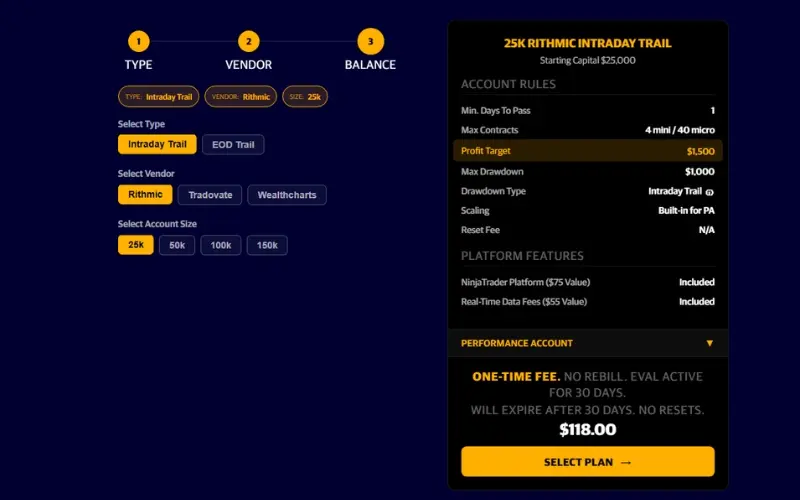
Here is the exact pricing and target breakdown for the Intraday trail evaluations:
| Size | Price | Profit target | Max drawdown | Daily loss | Max contracts |
|---|---|---|---|---|---|
| 25K | $118 | $1,500 | $1,000 | No | 4 |
| 50K Top Pick | $131.33 | $3,000 | $2,000 | No | 6 |
| 100K | $198 | $6,000 | $3,000 | No | 8 |
| 150K | $264.67 | $9,000 | $4,000 | No | 12 |
Verdict on Apex Trader Funding account types
The EOD drawdown account is statistically safer for beginners because it ignores unrealized intraday fluctuations. It prevents traders from failing due to normal market retracements, offering a massive psychological advantage during volatile sessions.
The Intraday account is highly unforgiving. It punishes traders who let winning trades turn into break-even trades, as the high-water mark calculation will silently consume their available drawdown buffer in the background.
3. Evaluation fees & account sizes
Apex utilizes a strict one-time fee model based on the specific parameters you choose. Evaluations expire after 30 days of active access, forcing traders to complete the challenge within the standard billing cycle timeframe.
There are no resets available on the new model. If you fail or run out of time, you must purchase a brand-new evaluation account to try again. The pricing scales logically based on the starting capital and the drawdown type you select.
Here is a direct comparison of the one-time upfront fees for both account types based on their starting size:
| Account size | EOD trail fee | Intraday trail fee |
|---|---|---|
| 25K | $199.00 | $118.00 |
| 50K Top Pick | $249.00 | $131.33 |
| 100K | $349.00 | $198.00 |
| 150K | $499.00 | $264.67 |
Verdict on Apex Trader Funding evaluation fees
The upfront cost provides excellent value because the lack of recurring monthly fees removes an ongoing financial drain. Traders no longer feel pressured to rush their evaluations just to avoid a second billing cycle.
However, the complete removal of account resets means mistakes are final. You must focus entirely on capital preservation to avoid purchasing a new account.
4. Performance Account (PA) activation fees
Passing the evaluation is not the final cost in your funding journey. You must pay a One-Time Activation Fee to unlock your Performance Account (PA). This payment covers data routing and platform licensing for the live environment.
The fee structure and account limitations vary slightly depending on the drawdown model and account size you choose. Below is the detailed breakdown for the Intraday Trail performance accounts:
| Feature | 25K Intraday | 50K Intraday | 100K Intraday | 150K Intraday |
|---|---|---|---|---|
| One-time activation fee | $79 | $89 | $99 | $109 |
| Activation deadline | 7 days from pass | 7 days from pass | 7 days from pass | 7 days from pass |
| Payout frequency | 5 trading days | 5 trading days | 5 trading days | 5 trading days |
| Max accounts | 20 | 20 | 20 | 20 |
| Max contracts | 2 mini / 20 micro | 4 mini / 40 micro | 6 mini / 60 micro | 10 mini / 100 micro |
| Scaling contracts | Yes | Yes | Yes | Yes |
| Max drawdown | $1,000 | $2,000 | $3,000 | $4,000 |
| Drawdown type | Intraday Trail | Intraday Trail | Intraday Trail | Intraday Trail |
| Daily loss limit | YES | YES | YES | YES |
| Consistency rule | 50% | 50% | 50% | 50% |
| Reset fee | N/A | N/A | N/A | N/A |
| Payout split | None - 100% | None - 100% | None - 100% | None - 100% |
| Inactivity policy | YES | YES | YES | YES |
| Max payout requests | 6 | 6 | 6 | 6 |
If you select the End of Day tracking model, the activation fees are slightly higher. Here is the detailed breakdown for the EOD Trail performance accounts:
| Feature | 25K EOD | 50K EOD | 100K EOD | 150K EOD |
|---|---|---|---|---|
| One-time activation fee | $99 | $109 | $119 | $139 |
| Activation deadline | 7 days from pass | 7 days from pass | 7 days from pass | 7 days from pass |
| Payout frequency | 5 trading days | 5 trading days | 5 trading days | 5 trading days |
| Max accounts | 20 | 20 | 20 | 20 |
| Max contracts | 2 mini / 20 micro | 4 mini / 40 micro | 6 mini / 60 micro | 10 mini / 100 micro |
| Scaling contracts | Yes | Yes | Yes | Yes |
| Max drawdown | $1,000 | $2,000 | $3,000 | $4,000 |
| Drawdown type | End Of Day | End Of Day | End Of Day | End Of Day |
| Daily loss limit | YES | YES | YES | YES |
| Consistency rule | 50% | 50% | 50% | 50% |
| Reset fee | N/A | N/A | N/A | N/A |
| Payout split | None - 100% | None - 100% | None - 100% | None - 100% |
| Inactivity policy | YES | YES | YES | YES |
| Max payout requests | 6 | 6 | 6 | 6 |
Verdict on Apex Trader Funding PA activation fees
Charging an activation fee is a standard industry practice for futures prop firms. It covers the real-world costs of providing professional data feeds and platform licenses to a funded trader.
The primary limitation here is the strict 7-day payment window. Forcing traders to pay this fee within a single week requires you to keep reserve capital on hand to secure your funded status.
5. Trading rules & payouts
The evaluation phase contains strict parameters designed to eliminate reckless trading and gambling. You must understand these rules completely to avoid an unnecessary and frustrating failure during a volatile trading session.
5.1. Evaluation rules & requirements
To successfully pass an evaluation, traders must demonstrate profitability and strict compliance with the firm's drawdown rules. The following general passing requirements apply to both account types:
- Profit target & time limit: You must reach your account's designated profit target within the 30-day evaluation access period.
- No minimum trading days: You can pass the evaluation in as little as 1 trading day as long as you hit your profit target and follow all rules.
- No Consistency Rule: The evaluation phase is meant only to test profitability and risk management. There are no consistency rules applied during this stage.
- Fixed position sizes: Contract limits remain fixed and do not scale up as your profits grow during the evaluation.
- Prohibited trading: You must use independent directional trading. Hedging multiple accounts against each other or attempting to circumvent the rules will result in immediate failure and account closure.
- Closing time: All open positions must be completely closed before 4:59 PM ET every single day. This mandatory rule applies to both End-of-Day and Intraday models, encompassing both Evaluation and Performance Accounts.
- Activation deadline: Once you successfully pass the evaluation, you have exactly 7 calendar days to pay the activation fee and move to a PA.
Traders selecting the End of Day evaluations must follow these specific parameters:
- EOD drawdown enforcement: Your maximum allowed drawdown threshold is calculated once per day at market close based on your End-of-Day balance. It never moves downward. However, if your account balance touches or falls below this set threshold at any moment intraday, you will immediately fail the evaluation.
- Daily loss limit (DLL): EOD accounts have a Daily Loss Limit. If you hit this limit, all open positions are liquidated and your trading is paused for the remainder of the day. Hitting this limit will not fail your evaluation.
Traders selecting the Intraday Trailing evaluations must follow a different set of risk rules:
- Real-time trailing drawdown: Your drawdown threshold moves dynamically in real-time alongside your highest achieved account balance, which includes unrealized gains. The threshold only moves up and never moves down. If your balance touches or drops below this threshold at any time, the evaluation immediately fails.
- No daily loss limit: There is no daily loss limit on these evaluation accounts. Your risk is managed entirely by the real-time trailing threshold.
5.2. Tradable assets & markets
Apex Trader Funding strictly limits trading to the futures market. You cannot trade options, single stocks, or standard forex pairs on this platform. The firm provides access to the major futures exchanges for diverse market exposure.
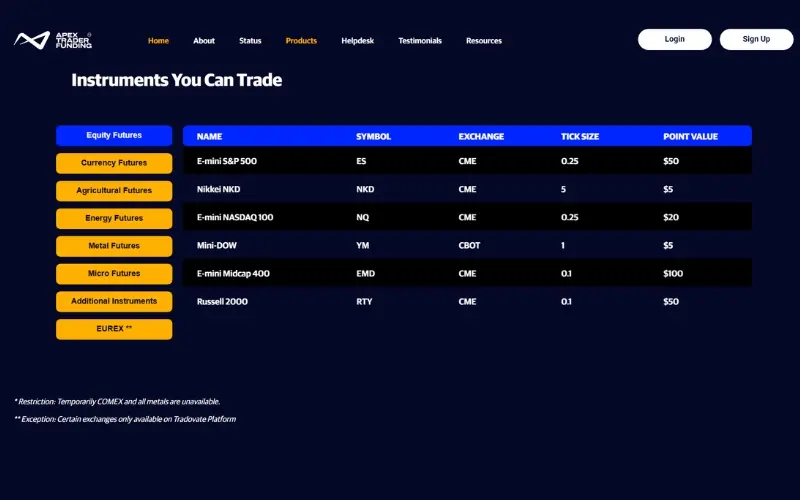
The allowed markets include the following broad categories and specific instruments:
| Asset Category | Available Instruments |
|---|---|
| Equity Futures | ES, NKD, NQ, YM, EMD, RTY |
| Currency Futures | N9, 65, 6J, 6E, 6C, 6B, 6A |
| Agricultural Futures | HE, LE, GF, ZC, ZW, ZS, ZM, ZL |
| Energy Futures | CL, QM, NG, QG, HO, RB |
| Metal Futures | GC, SI, HG, PL, PA, QI, QO |
| Micro Futures | MES, MYM, MNQ, M2K, MGC, M6A, M6E, MCL |
| Additional Instruments | Micro Bitcoin, Micro Ethereum |
| EUREX | FDAX, FDXM, FESX, FVS, FXXP, FDXS, FSXE, FGBX, FGBS, FGBM, FGBL |
Note: COMEX and all metal futures (such as Gold and Silver) are temporarily restricted. Certain EUREX exchanges are only available on the Tradovate platform. You should check the official announcements page for updates on instrument availability before starting your evaluation.
5.3. Supported trading platforms
Choosing the right data feed and software is critical for flawless futures execution. Apex supports several major platforms that cater to different trading styles and technical requirements.
You must choose the software that best fits your daily routine from the following options:
- Rithmic: Known for its robust technology and high-speed connectivity, this platform is built for algorithmic and high-frequency traders. It ensures rapid market data delivery and precise execution. However, it requires a Windows operating system or a virtual machine to run on Mac.
- Tradovate: This modern cloud-based solution offers a sleek interface with built-in charting and order management. It allows cross-device access on desktops, Macs, and mobile devices. It appeals to retail traders who value convenience and integrated tools.
- WealthCharts: This is a comprehensive next-generation platform featuring advanced market scanning tools and a built-in trade copier. It provides extensive educational resources and is ideal for traders looking for an all-in-one analysis environment.
You must also factor in commission fees when planning your trades. The simulated environment charges roughly $3.00 to $4.00 per round turn for standard e-mini contracts and about $0.50 to $1.00 for micro contracts. These simulated fees deduct directly from your available balance and will constantly impact your trailing drawdown tracking.
We recommend Tradovate for Mac users or traders who need browser-based flexibility without complex desktop setups. Conversely, we suggest Rithmic for serious scalpers executing high-frequency strategies, as its dedicated desktop application provides incredibly low-latency data routing to handle rapid order execution.
5.4. Payout rules & the 6-payout limit
The payout process dictates how and when you can actually access your earned capital. You must understand the following primary payout rules for both EOD and Intraday Trailing Performance Accounts before requesting a withdrawal:
- Minimum trading days: You must complete at least 5 qualifying trading days before you become eligible to request a payout.
- Minimum daily profit: Each of those 5 qualifying days must meet the minimum daily profit requirement based on your specific account size and type (for example, $100 or more for a 25K account). These qualifying days do not need to be consecutive, and there is no deadline or time limit to complete them.
- 50% consistency rule: No single profitable day can account for 50% or more of your total profit earned since your last approved payout. If one day's profit is too large, you must continue trading until that day's percentage falls below 50%.
- Safety net requirement: You are required to maintain a balance equal to your account's drawdown limit plus $100. You can only request a payout from profits that sit above this Safety Net.
- Minimum payout amount: The minimum amount you can request at one time is $500.
- Trading during requests: You can continue trading immediately after submitting a request. You must trade as if those funds have already been deducted from your account. If your balance dips below the required minimum threshold while the request is pending, it will simply be denied.
Every Performance Account operates on a strict life cycle capped at a maximum of six approved payouts. Once you successfully receive your 6th payout, the Performance Account is permanently closed.
Each of these 6 payout requests has a maximum dollar limit depending on your account size. Here are the specific withdrawal caps for the Intraday Performance Accounts across all six payout intervals:
| Payout # | 25K Intraday | 50K Intraday | 100K Intraday | 150K Intraday |
|---|---|---|---|---|
| 1 | $1,000 | $1,500 | $2,000 | $2,500 |
| 2 | $1,000 | $2,000 | $2,500 | $3,000 |
| 3 | $1,000 | $2,500 | $3,000 | $3,000 |
| 4 | $1,000 | $2,500 | $3,000 | $4,000 |
| 5 | $1,000 | $3,000 | $4,000 | $4,000 |
| 6 | $1,000 | $3,000 | $4,000 | $5,000 |
If you utilize the End of Day tracking model, the payout caps are structured slightly differently. Here are the limits for the EOD Performance Accounts:
| Payout # | 25K EOD | 50K EOD | 100K EOD | 150K EOD |
|---|---|---|---|---|
| 1 | $1,000 | $1,500 | $2,000 | $2,500 |
| 2 | $1,000 | $1,500 | $2,500 | $3,000 |
| 3 | $1,000 | $2,000 | $2,500 | $3,000 |
| 4 | $1,000 | $2,500 | $3,000 | $3,000 |
| 5 | $1,000 | $2,500 | $4,000 | $4,000 |
| 6 | $1,000 | $3,000 | $4,000 | $5,000 |
5.5. Withdrawal methods & processing times
Once your payout request is approved, the company uses specific payment gateways to distribute funds. To submit a request, you simply select the payout option from your dashboard for any eligible account. The available withdrawal methods depend entirely on your geographical location.
Here is a breakdown of the supported payment channels:
| Region | Payment gateway | Receive method |
|---|---|---|
| United States (US) | ACH Direct Deposit | Direct transfer to domestic bank account |
| International | Plane (Apex global partner) | Bank account transfers, Payoneer, Wise (formerly TransferWise), GCash, Revolut |
You must prepare for a multi-step clearing process when anticipating your funds. Here is the realistic timeframe you should expect from request to arrival:
| Phase | Estimated time |
|---|---|
| Payout approval | ~2 business days |
| Transfer from Apex to Plane/ACH | 3-4 business days |
| Bank processing time | 3-7 business days |
| Total realistic timeframe | 5-11 business days |
5.6. Copy trading & multiple accounts
Apex permits traders to manage multiple accounts at the exact same time to scale their earning potential. You may hold up to 20 Performance Accounts active simultaneously. Traders typically link these accounts using third-party trade copiers.
This mechanical process multiplies the execution from a master account across all linked follower accounts. If you enter a long position with one contract and make $100 on the master account, the trade copier duplicates that exact order across 19 other accounts. This generates $2,000 in gross profit from a single trading decision without requiring additional margin.
You must remember that losses are also multiplied. A single poor trading decision will inflict damage across your entire portfolio simultaneously. Managing the trailing drawdowns of 20 accounts creates massive psychological pressure, as one minor mistake can trigger liquidations across all your funded accounts at once.
Verdict on Apex Trader Funding trading rules
The intraday trailing threshold is stricter than the industry standard due to its tick-by-tick calculation of unrealized gains. This feature demands flawless trade execution and penalizes runners that pull back deeply.
The 6-payout cap is highly restrictive for professional traders looking for permanent long-term income, forcing a rapid churn of evaluation purchases.
6. Is the ROI worth it? Cost vs. maximum payout calculation
Evaluating the mathematical Return on Investment is crucial before committing your time to a challenge. The 6-payout cap creates a fixed maximum return for every account size you can purchase. You must weigh the upfront expenses against the exact dollar amount you can extract before the account permanently closes.
6.1. Full cost breakdown: All 8 account variants
You must calculate your total capital exposure by combining the one-time evaluation fee with the mandatory activation fee. Every account model requires you to pay both fees before you can place your first live trade. We have calculated the exact return multiplier for all eight account variations, assuming you pass the evaluation on your very first attempt.
| Account | Eval fee | Activation fee | Total cost | Max total payout | Gross ROI multiple |
|---|---|---|---|---|---|
| 25K Intraday | $118.00 | $79.00 | $197.00 | $6,000.00 | 30.46x |
| 50K Intraday Top Pick | $131.33 | $89.00 | $220.33 | $14,500.00 | 65.81x |
| 100K Intraday | $198.00 | $99.00 | $297.00 | $18,500.00 | 62.29x |
| 150K Intraday | $264.67 | $109.00 | $373.67 | $21,500.00 | 57.54x |
| 25K EOD | $199.00 | $99.00 | $298.00 | $6,000.00 | 20.13x |
| 50K EOD | $249.00 | $109.00 | $358.00 | $13,000.00 | 36.31x |
| 100K EOD | $349.00 | $119.00 | $468.00 | $18,000.00 | 38.46x |
| 150K EOD | $499.00 | $139.00 | $638.00 | $20,500.00 | 32.13x |
The data proves that the 50K Intraday account offers the absolute highest gross return on investment at a 65.81x multiple. The 25K accounts offer the poorest return metrics because the firm restricts your maximum withdrawal across all six payout periods to a flat $1,000.
6.2. Theoretical ROI vs. realistic ROI
The calculations in the previous section assume you navigate the strict evaluation rules flawlessly on your first attempt. Passing on the first try is mathematically rare due to the unforgiving intraday trailing drawdown. Every time you fail an evaluation, you must purchase a brand new account at full price. This directly reduces your overall return multiplier.
You can calculate your personal failure tolerance to understand exactly when an account stops being profitable. Using the highly efficient 50K Intraday account as our base metric, we modeled how your return multiple degrades with each subsequent failure.
| Attempts to pass | Total cost | Revised ROI multiple |
|---|---|---|
| 1 Attempt (0 fails) | $220.33 | 65.81x |
| 2 Attempts (1 fail) | $351.66 | 41.23x |
| 3 Attempts (2 fails) | $482.99 | 30.02x |
| 4 Attempts (3 fails) | $614.32 | 23.60x |
Because the total extractable payout is $14,500, a trader could theoretically fail the 50K Intraday evaluation 108 consecutive times and still remain mathematically profitable overall once they finally pass and complete all six payout cycles.
6.3. The hidden cost: Commission drag on profit
You must execute a large volume of trades to reach all six payout caps while satisfying the 50% consistency rule. Every trade you place incurs a commission fee of approximately $3.98 per round turn for standard e-mini contracts. The firm deducts these fees directly from your available balance. This constantly compresses your available drawdown buffer and eats into your final withdrawal amounts.
We estimate a conservative volume of 200 to 400 round turns to successfully complete a full six-payout life cycle.
| Trade volume | Commission cost | Net extractable profit (50K Intraday) |
|---|---|---|
| 200 Round Turns | $796.00 | $13,704.00 |
| 300 Round Turns | $1,194.00 | $13,306.00 |
| 400 Round Turns | $1,592.00 | $12,908.00 |
The theoretical maximum payout of $14,500 is strictly a pre-commission figure. Your actual realized profit will always be tangibly lower once you factor in the basic costs of executing your strategy in the live market environment.
6.4. The safety net: Permanently locked capital
The payout rules mandate that you maintain a fixed capital buffer inside your account at all times. This rule requires you to leave your maximum drawdown amount plus an additional $100 sitting untouched in your balance.
You must generate this profit to satisfy the safety net rule, but you can never withdraw it. When your account permanently closes after your final payout request, the firm reclaims this locked buffer entirely.
You must treat this forfeited safety net as an unrecoverable business expense. Adding this locked capital to your upfront fees reveals the true all-in cost of securing your payouts.
| Account size | Max drawdown | Safety net (Permanently locked capital) | Total true cost (Eval + PA + locked profit) |
|---|---|---|---|
| 25K Intraday | $1,000.00 | $1,100.00 | $1,297.00 |
| 50K Intraday | $2,000.00 | $2,100.00 | $2,320.33 |
| 100K Intraday | $3,000.00 | $3,100.00 | $3,397.00 |
| 150K Intraday | $4,000.00 | $4,100.00 | $4,473.67 |
This dynamic means you are constantly trading to build profit that belongs permanently to the firm, creating a hidden cost that never appears on the official marketing material.
6.5. Multi-account scaling: ROI at 20 accounts
The firm allows you to trade up to 20 accounts simultaneously using automated copy trading software. This operational feature drastically alters the return metrics. You multiply your upfront costs linearly, but you also scale your maximum payout potential to massive figures.
Using the optimal 50K Intraday account, we compared the mathematical potential of a single account against a fully maxed 20-account portfolio.
| Scenario | Total upfront cost | Max withdrawable payout | Permanently locked capital | Total profit needed |
|---|---|---|---|---|
| Single 50K Intraday | $220.33 | $14,500.00 | $2,100.00 | $16,600.00 |
| 20x 50K Intraday Accounts | $4,406.60 | $290,000.00 | $42,000.00 | $332,000.00 |
Trading 20 accounts requires you to generate $42,000 in locked capital across your portfolio. You must earn this money to satisfy the safety net rules, but it will never reach your bank account. You can extract substantial capital quickly using this method.
However, you must carefully monitor the compounding risk factors. A single severe losing streak will simultaneously wipe out the trailing drawdowns across all 20 accounts, forcing you to absorb a $4,400 loss instantly.
Disclaimer on ROI Calculations: All return multipliers and profit figures are theoretical. They assume you pass on the first attempt, maintain specific trade volumes, and clear all six payout cycles. Your actual returns will vary based on personal failure rates, commission costs, and trading discipline.
Verdict on Apex Trader Funding ROI
The mathematical ROI provided by the updated evaluation model is objectively exceptional. Even after you adjust your calculations to account for commission drag and permanently locked safety net capital, the upside potential far outweighs the initial risk.
Your realistic return heavily depends on your personal pass rate. The firm does not publicly disclose the average number of attempts required to pass an evaluation. We strongly recommend trading the 50K EOD account for the best pass-rate-adjusted return.
The End-of-Day drawdown calculation prevents normal market volatility from destroying your account buffer prematurely. This structural advantage significantly increases your probability of passing. A higher pass rate easily offsets the higher $358 total cost of the EOD model.
7. Legitimacy & restricted countries
Apex Trader Funding operates as a legally registered entity in the United States and has consistently distributed capital to successful traders since its inception. While they provide services to traders globally, there are specific regions where they cannot operate due to sanctions, embargoes, or payment provider limitations.
Canadian traders can fully utilize the firm's services. However, please note that as a Canadian resident, you cannot purchase a live account directly with Tradovate. You can access their services through Apex accounts instead.
You must verify your eligibility before purchasing. Here is the officially restricted countries list:
| Alphabetical group | Restricted countries |
|---|---|
| A - C | Afghanistan, Algeria, Azerbaijan, Bahrain, Bangladesh, Belarus, Benin, Brunei, Burkina Faso, Burundi, Cameroon, Central African Republic, Chad, China, Côte d’Ivoire, Cuba, Cyprus. |
| E - K | Egypt, Eritrea, Gabon, Grenada, Guinea, Guinea-Bissau, Haiti, Iran, Iraq, Jersey, Jordan, Kazakhstan, Kenya, Kosovo, Kuwait. |
| L - N | Latvia, Lebanon, Lesotho, Liberia, Libya, Madagascar, Maldives, Mauritania, Mauritius, Moldova, Mongolia, Morocco, Mozambique, Myanmar, Namibia, Nepal, New Caledonia, Nicaragua, Niger, Nigeria, North Korea. |
| O - S | Oman, Pakistan, Palestine (State of), Papua New Guinea, Qatar, Republic of the Congo, Réunion, Russia, Rwanda, Saint Pierre and Miquelon, Saudi Arabia, Senegal, Serbia, Somalia, South Africa, South Sudan, Sri Lanka, Sudan, Syria. |
| T - Z | Tanzania, Togo, Trinidad and Tobago, Tunisia, Türkiye (Turkey), Uganda, Ukraine, Uzbekistan, Vanuatu, Venezuela, Vietnam, Western Sahara, Yemen, Zambia, Zimbabwe. |
Verdict on Apex Trader Funding legitimacy
The firm's legal registration and public payout history solidify its legitimacy in the proprietary trading space. They deliver on their promise to fund traders who successfully navigate the evaluation rules.
However, the extensive restricted countries list is a significant barrier for international traders. Attempting to bypass these geographical restrictions with a VPN will result in immediate account termination.
8. Customer support quality
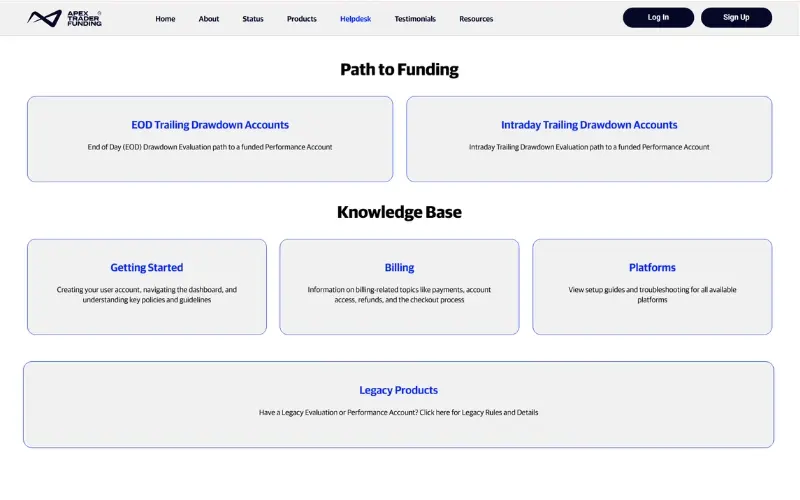
The firm provides a ticketing system via a Help Desk for all technical and billing assistance. Based on standard operational metrics, ticket response times typically range from 24 to 48 hours during the business week. Support volume heavily dictates these times, and traders frequently experience delays during major promotional periods or end-of-month payout cycles.
They provide a comprehensive help center packed with detailed articles and platform connection guides to assist new users. The knowledge base covers essential routing errors, Rithmic connection drops, and software integrations thoroughly. This extensive documentation ensures you have the necessary resources to troubleshoot basic issues independently.
Verdict on Apex Trader Funding customer support
We rate their overall customer support reliability as excellent for a firm of this size. They resolve billing issues and technical platform routing errors with high efficiency once a ticket is processed.
The robust help center provides immense value for traders seeking quick answers. While they rely on a ticketing system instead of live chat, the sheer volume of self-help articles makes up for this structural choice.
9. Trader feedback & community reviews
Analyzing community feedback reveals exactly how the firm's rules impact daily trading behavior. Community sentiment provides a realistic view of the company's operational reliability beyond their standard marketing material.
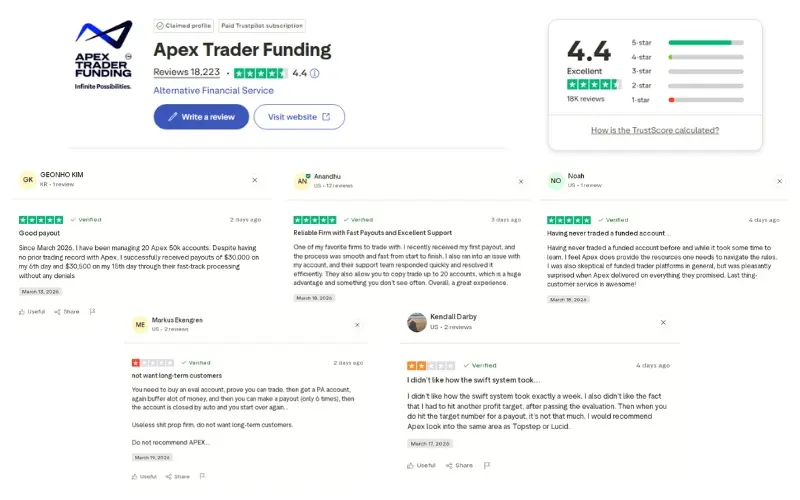
As of March 30, 2026, Apex Trader Funding holds a 4.4-star rating on Trustpilot from over 18,000 reviews. Based on aggregated user data across major platforms, the feedback points to specific strengths and weaknesses:
- Fast payouts and scaling limits: Many positive Trustpilot reviews highlight the efficiency of the payout process for users managing maximum accounts. One trader noted successfully receiving $30,000 on their 6th day and $30,500 on their 15th day across multiple linked 50K accounts without any denials.
- Support and educational resources: Users frequently praise the customer support team for resolving platform routing issues quickly. They also appreciate the provided resources, noting that the firm delivers precisely on the rules they outline.
- The 6-payout cap frustration: The most prominent negative feedback centers around the firm's lifespan limit. Traders express extreme frustration that accounts are automatically closed after the 6th payout, forcing them to purchase new evaluations, rebuild their buffer, and start over.
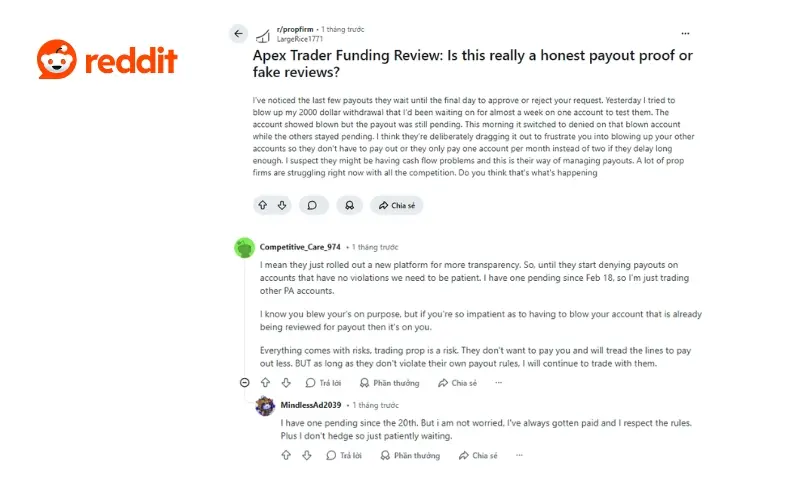
- Processing delays and transparency: On Reddit, discussions heavily focus on the payout review timeline. Some users note that the firm occasionally waits until the final day of the processing window to approve or deny requests. However, experienced users point out that as long as traders strictly follow the consistency rules and avoid prohibited behavior, the firm consistently honors payouts under their transparent platform rules.
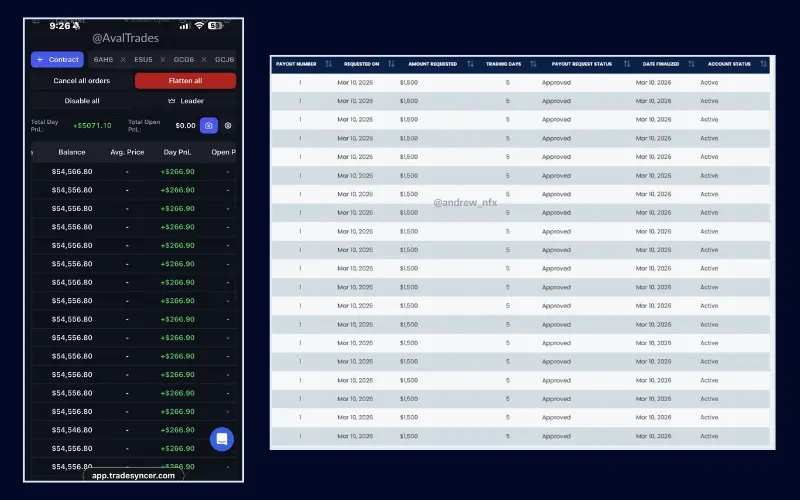
When you research the firm's reliability, you will find visual proof of successful withdrawals circulating within trading communities. Many funded traders actively share their approved payout certificates and bank deposit screenshots to validate the process.
Seeing this tangible proof can help alleviate your concerns about the new consistency rules and processing timelines. Below is some example of verified payout shared by a successfully funded trader.
Verdict on Apex Trader Funding community sentiment
The community consensus is ultimately positive regarding the firm's ability to pay out large sums quickly if you follow the rules perfectly. Traders appreciate the straightforward platform integration and massive scaling potential.
However, professional traders remain highly critical of the restrictive 6-payout cap. The community acknowledges that while Apex is excellent for rapid capital extraction, it no longer serves as a reliable home for a permanent career account.
10. Who should use Apex Trader Funding (and who shouldn't)
The 2026 rule changes make this firm highly specialized. It now caters to a very specific type of risk profile and capital extraction strategy.
10.1. Who should use Apex Trader Funding
The following traders align perfectly with the updated business model based on the data:
- Traders looking for fast initial payouts with low upfront evaluation costs.
- Scalpers who understand how to execute 20-account copy trading systems effectively.
- Traders who prefer paying a one-time fee instead of dealing with ongoing monthly subscriptions.
10.2. Who should NOT use Apex Trader Funding
The following traders will likely struggle with the firm's specific restrictions:
- Traders wanting to build a massive permanent balance in a single account over multiple years.
- Swing traders who cannot tolerate strict consistency rules governing their daily profit distribution.
- Traders residing in any of the restricted countries listed by the firm's compliance team.
11. Apex vs. competitors (Topstep, TradeDay)
The market offers several alternatives with different rule structures. You must compare the structural differences to find the best fit for your trading style. Topstep and TradeDay act as the primary competitors in the futures space.
Here is how the core metrics compare across the leading options:
| Feature | Apex Trader Funding | Topstep | TradeDay |
|---|---|---|---|
| Asset Types | Futures | Futures | Futures |
| Challenge Type | 1-Step Evaluation | 1-Step Evaluation | 1-Step Evaluation |
| Fee Structure | One-time fee | Monthly fee | One-time fee |
| Trading Platforms | Rithmic, Tradovate, WealthCharts | TopstepX | Tradovate, NinjaTrader, TradingView |
| Account Lifespan | 6-payout cap | Permanent | Permanent |
| Drawdown Type | EOD or Intraday | End of Day | EOD, Intraday, or Static |
| Payout Cycle | Every 5 days | Weekly/Daily | Daily upon threshold |
| Consistency Rule | 50% | 40% (Consistency Path) | 30% |
Verdict on Apex Trader Funding vs competitors
High-volume scalpers who want to utilize 20-account copy trading and rapid 5-day payout cycles should still choose Apex. The profit multiplier effect across multiple accounts outweighs the strict 6-payout cap.
Traders seeking a permanent, single-account career should look toward Topstep or TradeDay. Topstep is ideal for traders who prefer the dedicated TopstepX platform and an End of Day drawdown, although it requires a monthly fee.
TradeDay provides a strong alternative with a one-time fee structure, TradingView integration, and flexible drawdown options like Static or EOD. However, TradeDay enforces a stricter 30% consistency rule compared to the 50% rule at Apex.
12. How to sign up Apex Trader Funding
Starting your journey requires navigating the firm's specific onboarding pipeline. Follow these exact instructions to register and secure your account without technical errors:
- Navigate to the official portal at dashboard.apextraderfunding.com.
- Click on the "Sign Up" button to initiate the account creation process.
- Fill out the required personal information accurately to ensure no delays during future payout verifications.
- Check your inbox and confirm your email address to authenticate your new profile.
- Select your preferred membership type by choosing your evaluation account size, drawdown model (EOD or Intraday), and data vendor (Rithmic or Tradovate).
- Pay the upfront evaluation fee to activate your dashboard and begin your trading journey.
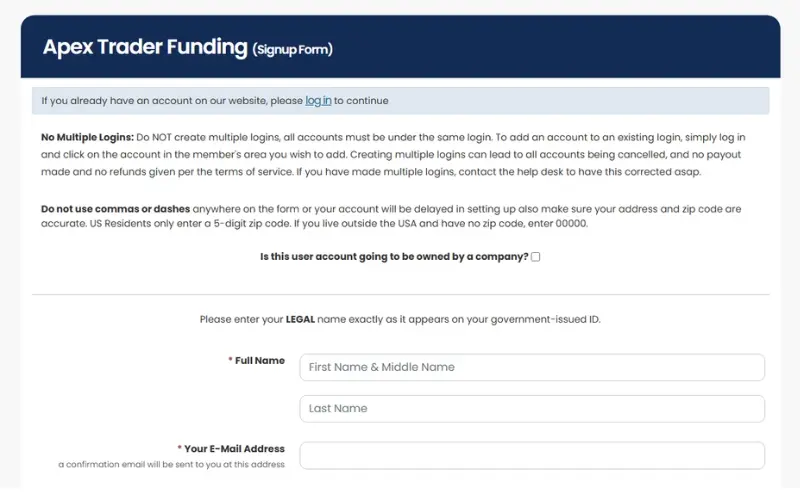
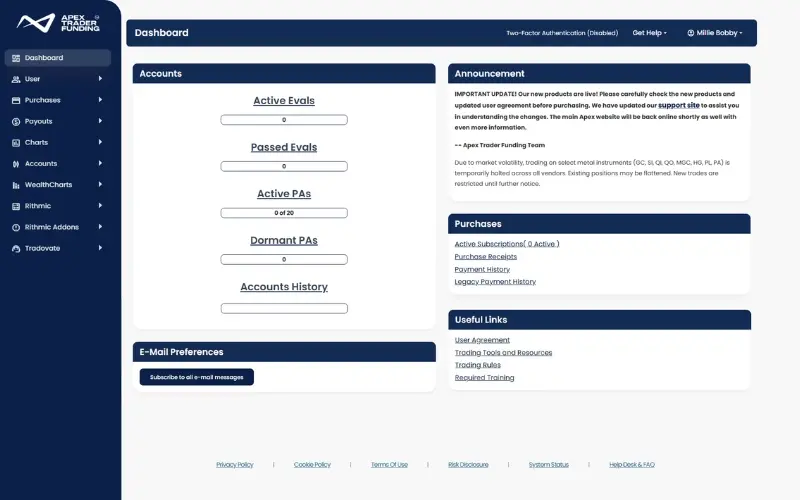
Alternatively, you can browse and select your preferred account size directly from the apextraderfunding.com/#products to begin the registration process.
13. Tips to pass the evaluation
Passing requires a defensive strategy rather than just predicting market direction. Protecting your downside is infinitely more important than hunting large, sweeping wins.
You should actively utilize the dashboard's real-time tracker to monitor your daily drawdown consumption. The tracker clearly separates realized and unrealized profit visually. Seeing the exact dollar amount of your remaining buffer in real-time removes a significant source of anxiety and helps you decide when to step back after a losing streak.
Follow these two core strategies to protect your account buffer:
- The buffer first strategy: Trade the smallest position size possible until your account balance is safely above the starting balance. Securing this initial buffer prevents a single, unlucky early loss from instantly failing the evaluation.
- Using Micros (MES/MNQ) to pass safely: Trade Micro contracts instead of Mini contracts to tightly limit your tick-value risk. Using micros reduces the violent impact of volatility on your trailing threshold, allowing you to survive normal market breathing.
14. FAQs about Apex Trader Funding
14.1. Is Apex Trader a good prop firm?
Apex is a highly structured prop firm suitable for traders who understand strict risk management. The one-time fee model makes it cost-effective, but the stringent payout rules require immense discipline to navigate successfully.
14.2. Does Apex trading actually payout?
Yes. The firm processes payouts for traders who meet the safety net requirements, complete the qualifying trading days, and adhere strictly to the 50% consistency rule.
14.3. What is the 30% rule in Apex Trader?
This is a dead rule from the legacy system. The firm replaced it during the March 2026 update. The current rule is a 50% consistency rule, meaning no single day can account for 50% or more of your total requested withdrawal amount.
14.4. Is Apex Trader Funding beginner friendly?
The EOD drawdown accounts are beginner friendly because they offer daily flexibility by ignoring intraday fluctuations. The Intraday trailing drawdown accounts are highly advanced and typically cause beginners to fail rapidly due to the tick-by-tick calculation.
14.5. What happens after 6 payouts on Apex?
After receiving the 6th approved payout, your Performance Account is permanently closed. You must purchase and pass a brand-new evaluation account to resume trading with the company.
14.6. I purchased an Apex account before March 1, 2026. Am I affected by the new rules?
No. Legacy accounts purchased before March 1, 2026 are fully protected and continue to operate under their original rule set until the account is closed. You are not subject to the new 50% consistency rule, the 6-payout cap, or the EOD/Intraday account split. The original 30% consistency rule remains in effect for your existing account.
14.7. Can I convert my legacy account into one of the new EOD or Intraday Performance Accounts?
No. Apex does not allow legacy accounts to be converted into the new account types. Once your legacy account closes naturally, any new evaluation you purchase from that point forward will automatically follow the updated March 2026 rules.
14.8. Do I need prior futures trading experience before attempting an Apex evaluation?
Apex imposes no formal experience requirement, but the evaluation environment is completely unforgiving for traders who do not understand futures mechanics.
On the Intraday Trailing account in particular, a single trade that runs unrealized profit and then pulls back to break-even can silently consume a large portion of your drawdown buffer without triggering any visible loss warning.
For traders new to futures, starting with a 25K EOD account is strongly recommended to build familiarity with the drawdown system before committing to larger sizes.
15. Final verdict
This updated Apex Trader Funding review highlights a company that has fundamentally changed its relationship with retail traders.
By trading recurring evaluation fees for a strict capped-payout model, the March 2026 changes require a massive shift in your execution strategy. The 6-payout cap and the 50% consistency rule demand a methodical, short-term approach to extracting capital safely.
Apex Trader Funding is no longer built for traders seeking a single, permanent career account. Instead, it has become the most efficient vehicle in the industry for rapid capital extraction through account scaling.
If you are a disciplined scalper who knows how to leverage 20 accounts simultaneously, the upfront mathematical return of spending a few hundred dollars to potentially extract tens of thousands is undeniably favorable.
If you decide to proceed with Apex, consider this general blueprint to help secure a payout:
- Step 1: Select a $50,000 EOD account. The End-of-Day drawdown calculation removes the psychological stress of the intraday trailing threshold and provides more breathing room.
- Step 2: Build an initial buffer. Trading micro contracts initially to secure at least a $500 buffer above the starting balance can help manage early risk.
- Step 3: Manage daily profit distribution. Steady, measured daily gains prevent massive outlier profits and help navigate the 50% consistency rule.
- Step 4: Request payouts efficiently. Requesting payouts on the 5th qualifying trading day is often more effective than building a massive balance, because the 6-payout cap makes long-term holding mathematically inefficient.
If you have a strict risk management framework and are ready to execute this capital extraction strategy, you can start your Apex Trader Funding evaluation here.
- Apex Trader Funding official website - https://apextraderfunding.com/
- Apex Trader Funding help center - https://apextraderfunding.com/help-center/